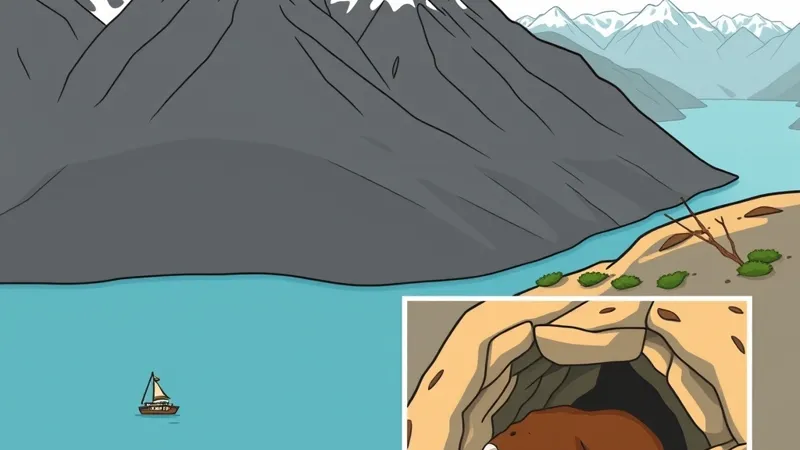
What connects Última Esperanza Fjord, its name and Milodón Cave?
Última Esperanza means “Last Hope”: it names the fjord beside Puerto Natales and the surrounding province. Nearby Milodón Cave belongs to the same regional landscape but is a separate natural monument, not a site inside Torres del Paine National Park.
The European place-name is associated with navigator Juan Ladrillero’s search for a passage to the Strait of Magellan. The cave’s importance is different: preserved remains made it a significant site for studying an extinct ground sloth, Mylodon darwinii.
Historical context belongs with the collections of Memoria Chilena; protected-area information belongs with CONAF.
Where is the fjord in relation to Puerto Natales and Torres del Paine?
Puerto Natales sits beside Última Esperanza Fjord; the cave and national park are separate inland destinations. The province is an administrative area, not another name for the fjord or park.
Orientation map — schematic, not to scale
- Regional frame: Última Esperanza Province contains Puerto Natales and Torres del Paine.
- Waterfront reference: Puerto Natales → Última Esperanza Fjord.
- Inland excursion: Puerto Natales → Milodón Cave Natural Monument, northwest of town.
- Separate park journey: Puerto Natales → Torres del Paine National Park, farther north.
This schematic is not a navigation map. A Puerto Natales-to-Milodón Cave road distance depends on the departure point and entrance used; a straight-line measurement is not a driving route. Check your transport’s route rather than borrowing a national-park transfer estimate. CONAF’s monument and park information should be consulted separately.
Why is the fjord called Última Esperanza?
The usual naming account links “Last Hope” to Ladrillero’s search for access to the Strait of Magellan. It does not establish precisely what he felt.
Expedition chronology and the date a place-name was assigned are different historical questions. Later summaries often compress them into a simple story. Memoria Chilena, the National Library’s digital collection, provides historical context for distinguishing voyage records from later retellings.
The European name does not mark the beginning of regional history. Indigenous relationships with these waterways and lands long predate European navigation and naming.
How did glaciers shape the fjord and cave?
The fjord and cave belong to a glacial landscape, but they are not identically carved features. A fjord is a marine inlet occupying a valley shaped by glacial erosion and subsequently occupied by seawater.
CONAF’s monument interpretation connects the cave’s development with an ancient lake environment and erosion at the rock face as the regional ice and water landscape changed. That differs from a glacier excavating a marine valley.
The fossil deposits are another layer of the story: the creation of a cavity and the later accumulation and preservation of animal remains are separate events.
What was the milodón, and why does the cave matter?
The milodón was an extinct ground sloth, not a dinosaur. Its scientific name is Mylodon darwinii, and the cave provides evidence about its biology and disappearance.
Evidence box — remains, interpretation and reconstruction
- Discovery history: finds include unusually preserved animal material, including skin and hair. Chile’s National Museum of Natural History provides context for the animal and its remains.
- Dating: an Ecography study of megafaunal extinction at Última Esperanza examines dated evidence. Radiocarbon ages and calibrated calendar ages are not interchangeable.
- Appearance: the model visitors may encounter is a reconstruction, not a preserved animal.
- Limits: human and animal evidence in the same broader landscape does not, by itself, demonstrate a direct encounter or hunting event.
What should you check before visiting Milodón Cave?
Check the monument’s own entry information rather than applying Torres del Paine’s ticket rules. Use CONAF and Pases Parques to confirm visit arrangements.
- Admission: opening hours, entry categories, booking procedures and temporary restrictions.
- Routes: open paths, officially listed lengths and elevation information.
- Accessibility: steps, slopes, surfaces, accessible facilities and assistance arrangements. A short path is not automatically wheelchair-accessible.
- Facilities: toilets, visitor services and interruptions.
- Transport: drop-off, collection and arrangements if your visit runs late.
Monument admission, transport and guiding are separate purchases unless the booking explicitly combines them. Check which admission your booking includes.
How can you experience the fjord from Puerto Natales?
You can see the fjord from the waterfront without boarding a boat. Shore visits offer flexible timing; navigation excursions travel farther into the maritime landscape and require a more structured commitment.
For Balmaceda and Serrano glacier excursions, compare the advertised route, boarding point, transfers, duration, landings and cancellation conditions. Weather can disrupt navigation, landings and glacier visibility; wildlife sightings are uncertain.
Compare the advertised inclusions on our Balmaceda and Serrano boat-trip page. The current starting price is on the tour page, with live prices and ratings in its GetYourGuide widget.
Can you combine the cave and fjord with Torres del Paine?
Yes, conditionally: a waterfront visit and a full navigation need different scheduling. A boat excursion and cave visit may not fit into the same day.
- During a Puerto Natales stay: arrange the cave around confirmed transport and fit a waterfront walk around other plans.
- Before or after the W: leave room for delays, equipment preparation and recovery.
- For navigation: protect the advertised excursion window and avoid tight onward connections.
Self-arranged travel offers control over stops but leaves transport coordination with you. Guided options may simplify transfers, although pickup areas and entry inclusions vary.
Our guided versus self-guided W comparison, day-tour comparison and accommodation guide help connect these choices. Torres del Paine Guide is an independent editorial guide, not a tour operator. Affiliate bookings may earn us a commission.
What weather and conservation guidance matters?
Forecasts, official alerts and departure notices are more useful for immediate decisions than historical climate averages. Wind and rain can affect waterfront walks, road journeys and sailings differently.
Consult MeteoChile forecasts, SENAPRED alerts, CONAF notices and your excursion provider’s departure advice. A regional forecast alone does not establish whether a vessel will sail.
For monument-specific instructions on permitted routes, fossil protection, wildlife disturbance and restricted activities, consult CONAF and posted visitor information. National-park regulations should not be assumed to apply identically at the monument.
What do visitors ask about Última Esperanza and Milodón Cave?
These answers distinguish the destinations and their names; access and scheduling depend on current visitor information.
What does Última Esperanza mean?
Última Esperanza means “Last Hope.” The naming account associates it with Ladrillero’s search for a passage to the Strait of Magellan; Memoria Chilena provides historical context.
Is Milodón Cave inside Torres del Paine, and does it have other names?
No. Milodón Cave Natural Monument is separate from Torres del Paine National Park. Milodón Cave, Cueva del Milodón and Mylodon Cave name the same attraction; consult CONAF for protected-area information.
Do you need a boat to see the fjord?
No. Puerto Natales’s waterfront offers views of Última Esperanza Fjord. Boat trips offer a different perspective; consult the advertised itinerary for boarding and access details.
Was the milodón a dinosaur?
No. Mylodon darwinii was an extinct ground sloth, a mammal. The National Museum of Natural History provides paleontological interpretation.
Can cave and boat visits share a day?
Only if confirmed schedules and transfers allow it. Check monument access with CONAF and Pases Parques, and obtain excursion return and cancellation arrangements before combining bookings.
Sources
Protected-area sources address access; historical collections and scientific research address interpretation. They serve different purposes.
- CONAF: protected-area identity, monument interpretation and visitor notices.
- Pases Parques: official protected-area ticket information.
- Memoria Chilena: National Library historical collections and navigation context.
- National Museum of Natural History: paleontological collections and ground-sloth interpretation.
- Ecography: megafaunal extinction study: dated paleontological evidence from Última Esperanza.