What is the easiest way to get to Torres del Paine?
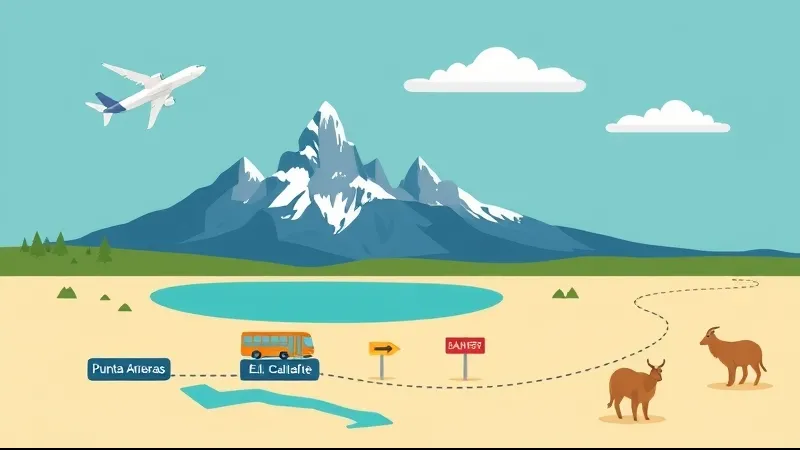
Torres del Paine National Park has no airport of its own, so every traveller arrives through one of three gateways: Punta Arenas (PUQ) in Chile, Puerto Natales (PNT) in Chile, or El Calafate (FTE) in Argentina. Puerto Natales is the closest town to the park and the standard base — the scheduled park buses, the transfer companies, the supermarkets and the outdoor shops are all there.
Each gateway does a different job. Punta Arenas has the most flight connections from Santiago and is where most long-haul itineraries land, then continues north by road. Puerto Natales has a smaller airport with a reduced seasonal schedule, but it is the road hub for everything that enters the park. El Calafate is the Argentine option, used by people combining Los Glaciares with Torres del Paine, and it requires an international land border crossing at Cerro Castillo / Río Don Guillermo.
Inside the park there are three official portals run by CONAF, the Chilean national park authority: Laguna Amarga, Sarmiento and Serrano, next to the Administración. Entry tickets are not something you sort out at the gate on the day — they are bought online in advance through the state platform pasesparques.cl and shown at the portal on arrival.
Which airports serve Torres del Paine?
Three airports serve the park, and only one of them is inside Chilean Patagonia's main flight network.
- Presidente Carlos Ibáñez del Campo International Airport (IATA: PUQ), Punta Arenas — the main gateway for the Chilean side, with the densest connections to Santiago (SCL) and links to Puerto Montt (PMC). It operates year-round and is overseen by Chile's Dirección General de Aeronáutica Civil.
- Teniente Julio Gallardo Airport (IATA: PNT), Puerto Natales — the closest airport to the park, but it runs a reduced seasonal schedule concentrated in the austral summer. Routes come and go from one season to the next, so treat it as a bonus rather than the backbone of a plan, and check current services before you build an itinerary around it.
- Comandante Armando Tola International Airport (IATA: FTE), El Calafate, Argentina — the Argentine gateway, connected mainly to Buenos Aires (Aeroparque AEP and Ezeiza EZE) and operated within the Aeropuertos Argentina network.
The practical consequence: if you want certainty of arriving, fly into PUQ. If PNT has a service that matches your dates, it saves you a road leg. If you are already in Argentine Patagonia, FTE puts you one bus ride and one border post from Puerto Natales.
How do you get from Punta Arenas to Torres del Paine?
The standard route is fly into PUQ, travel north to Puerto Natales along Ruta 9 by scheduled bus or rental car, sleep in Puerto Natales, then continue into the park the next morning.
Buses leave from the Punta Arenas terminal on fixed daily departures. According to the published catalogue of Bus-Sur, one of the regular operators, the Punta Arenas–Puerto Natales run takes about 3h15, with around 11 departures per direction per day in high season and 9 to 10 in low season. High-season fares are quoted at CLP 9.000 one-way and CLP 18.000 return; in low season the same catalogue lists CLP 10.000 semi cama and CLP 14.000 salón cama. Timetables and fares change — check the operator's site before you book.
Almost nobody goes straight from the airport into the park in one day, and there is a reason: the park bus schedule from Puerto Natales is built around morning departures, so arriving in Natales in the afternoon and starting fresh the next day is simply how the connection works. In the December–February high season, book buses and private transfers ahead; seats and vehicles do sell out. General destination information is published by Chile Travel, the official tourism board.
How do you travel from Puerto Natales into the park?
Puerto Natales is the operational base, and the Rodoviario bus terminal is where the day starts. CONAF lists four regular bus companies serving the park from Puerto Natales: Bus-Sur, Buses Gómez, Turismo Zaahj and Buses Base Torres.
Scheduled departures along Ruta Y-150 leave at 07:00 and 12:00, with an additional 14:30 service and an 18:00 service from November. The 07:00 bus reaches Laguna Amarga at about 09:00 and Pudeto at about 10:00. Published fares start at CLP 15.000 for one leg and CLP 28.000 return, rising to CLP 25.000 / CLP 40.000 for the Grey sector. Buses stop at Laguna Amarga first, then continue to Pudeto and on to Administración/Serrano. Return departures are limited in number each day, which is the detail that catches people out: miss the last one and you are staying inside the park whether you booked a bed or not.
Self-drivers use the same road. Either way, buy fuel, food and anything you might need in Puerto Natales — services inside the park are minimal, and prices and opening hours at the few points of sale are not something to build a plan on. If you are still deciding where to sleep before and after the park, our hotels overview and the getting there hub set out the options.
Can you get to Torres del Paine from El Calafate, Argentina?
Yes — and it is a common combination for people who want Los Glaciares and Torres del Paine on one trip. The international bus runs from El Calafate via Río Turbio or Cerro Castillo and crosses into Chile at the Río Don Guillermo / Cerro Castillo border post, continuing to Puerto Natales.
What you need on the day:
- A passport. Foreigners also need the Chilean TUM migration slip; carriers refuse boarding if documents are not in order.
- A completed Chilean SAG agricultural declaration. Declare all plant and animal products, including fruit, vegetables, meat, dairy, seeds and honey. SAG inspects them and decides whether entry requirements are met; declaring a product does not guarantee admission.
- Time. Two immigration and customs stops, one Argentine and one Chilean, sit inside the journey. Border formalities are slower on busy summer mornings.
Entry and exit formalities on the Chilean side are handled by the Servicio Nacional de Migraciones; the Argentine national park side of the itinerary is documented by the Administración de Parques Nacionales.
If you are still choosing between the two towns as a base, we compare them directly in Puerto Natales vs El Calafate, and there are guided day trips from El Calafate into the park for travellers who would rather not manage the crossing themselves.
Which park entrance should you choose?
Pick the entrance that matches your first night's accommodation, not the other way round. That single rule prevents most itinerary problems.
- Laguna Amarga — the usual access for the eastern sector and the Base Torres area. It is the first stop for the morning buses from Puerto Natales and the portal most trekkers use.
- Sarmiento — lakeside access on the eastern side, quieter, generally used by self-drivers.
- Serrano / Administración — access to the southern and western sector, including the routes towards Paine Grande and Grey.
All three are CONAF-controlled, and registration at every ranger station (guardería) is mandatory: you sign in, and the rangers know you are on the trail. Park opening hours also depend on the season — 07:00 to 21:00 from October to April, 08:00 to 18:30 from May to September — so a late arrival at the wrong portal is a wasted afternoon.
Do you need to book park entry and accommodation in advance?
Yes, both, and they are two separate bookings.
Park entry is sold online only, through the government platform pasesparques.cl, and must be bought at least 24 hours ahead. The official tariff published by Parque Nacional Torres del Paine for foreign visitors is:
- Foreign adult (18–59): CLP 32.400 for a day pass, or CLP 48.500 for the "2 or more days" pass, valid up to 10 consecutive days
- Foreign teens (13–17): CLP 16.600 day pass
- Ages 0–12: free
Check the official page before you pay — tariffs are revised by the authority, not by us.
Accommodation inside the park is run by private concessionaires with their own booking systems, and the summer season sells out months ahead. The western refugios and campsites (Paine Grande, Grey, Dickson) are operated by Vértice Patagonia; the eastern ones (Central, Chileno, Cuernos, Francés, Serón) by Las Torres Patagonia, the company formerly named Fantástico Sur. Free or wild camping is strictly forbidden — the CONAF map lists Italiano and Paso as ranger posts, not campsites.
Cancellation terms matter here because they are stricter than most hotel bookings. Las Torres' policy for individual trek bookings is no penalty 90+ days ahead, 20% at 89–70 days, 50% at 69–45 days and 100% at 44–0 days. We do not quote nightly rates: they change, and the operators' own sites are the only correct source.
CONAF also frames the treks themselves: the W is officially "3 a 5 días" and requires accommodation bookings, while the O — the Circuito Macizo Paine — is "8 a 10 días", with a one-way restriction on the Serón–Paso section.
Is renting a car worth it in Chilean Patagonia?
A car buys flexibility at the eastern portals and around the lakes; it does not buy you a shortcut on the trails, and it comes with real friction.
Arguments for: you set your own start time, you can reach Sarmiento and the quieter viewpoints without waiting for a bus, and you are not tied to the limited number of return departures each day.
Arguments against, honestly:
- Gravel. Much of the internal road network is unsealed. Read the gravel-damage clause in the rental contract before signing — windscreen and paintwork damage is frequently excluded from standard cover.
- Cross-border paperwork. Taking a Chilean rental car into Argentina requires additional authorisation from the rental company, arranged in advance and usually charged for. Turning up at Cerro Castillo without it means turning round.
- Wind. Follow the current park notices and weather forecast; bring suitable layers for wind, rain and cold.
- Fuel. Filling stations north of Puerto Natales are scarce. Fill up before you leave town.
- Roads and parking. Sections of the internal network are one-way, and trailhead parking is finite; in high season it fills early in the morning.
Road conditions and works on the regional network are published by Vialidad, the Chilean road authority under the Ministry of Public Works. For anyone who would rather skip the driving altogether, the day tours compared page sets out what each option actually covers.
How does the Pudeto catamaran fit into your route?
The Lago Pehoé catamaran between Pudeto and Paine Grande is the standard link into the western sector, and for most people it is the start or the end of the W trek. Miss it and there is no quick alternative — the walk around the lake is not a substitute you improvise on the day.
It is operated by a private concessionaire, Hielos Patagónicos, with its own ticketing at catamaranpehoe.com. Published terms: CLP 28.000 per person per leg, children aged 10 and under free with a paying adult, and cancellation 72 hours or more ahead refunds CLP 23.000 — later, nothing.
Sailings are limited and seasonal. The summer timetable (16 October–15 April) runs up to four crossings a day, departing Pudeto at 08:00, 10:30, 16:15 and 18:00. The winter timetable contracts sharply — sailings on the 15th and 30th of each month at 11:00. Check the operator's site before you commit to a route.
And the part nobody likes: high winds cancel sailings. A cancelled catamaran does not just delay you, it changes your whole route, because your bed that night is on the other side of the lake. Build slack into the plan and keep a fallback night in Puerto Natales in mind.
What time of year is best for reaching the park?
The austral summer, roughly December to February, gives you the most transport and the most people; the shoulder months are the balance point; winter reduces almost everything.
Wind and changing weather can affect access, trails and sailings. Check the current forecast and the operator’s updates; no particular view or sailing is guaranteed. Daylight swings hard at this latitude: long evenings around the summer solstice (21 December) and short days around the winter solstice (21 June). The park's own notice is blunt: weather changes fast, and you should carry layers for rain, wind and/or snow in any month.
Checked 13 September 2026: the current park notice requires an accredited specialist guide on Base Torres and the W from 27 April to 15 September 2026, or while the winter conditions persist. The June 2026 regulation limits W/Base Torres groups to four visitors per guide; an assistant does not count as a guide. Winter equipment is mandatory and the Base Torres entry cutoff is 09:00. Check current notices before travelling; a date alone does not guarantee access. Pases Parques · CONAF, 2026.
What should you arrange before you leave home?
- Passport valid for the whole trip, plus the Chilean tourist card issued on entry — keep it, you hand it back when you leave.
- Park entry ticket bought online on pasesparques.cl, at least 24 hours before you arrive.
- Refugio or campsite confirmations from Vértice Patagonia and Las Torres Patagonia, printed or downloaded offline.
- Travel insurance that explicitly covers trekking — check the altitude and activity wording, not just the brochure.
- Cash in Chilean pesos. Card coverage is inconsistent once you leave Puerto Natales.
- Offline maps. Mobile coverage inside the park is patchy and cannot be relied on for navigation.
Two rules are worth internalising before you arrive. Torres del Paine is a UNESCO Biosphere Reserve, and any open flame is banned under Ley 20.653: fines reach CLP 2.000.000 and offences carry up to three years in prison. Camp stoves are allowed only in designated areas. That severity is not bureaucratic theatre — the fire that started near Lago Grey on 27 December 2011 burned more than 17.600 hectares. Recreational drones are also banned, and offenders are expelled from the park and reported to the DGAC.
On wildlife: CONAF lists puma, guanaco, huemul, culpeo and chilla foxes among the park's mammals, along with condors among its birds. Sightings are never guaranteed, in any season, by anyone. If a puma does appear, the official protocol is to stay calm, never run, never approach, and back away slowly while facing the animal.
Frequently asked questions
Is there an airport at Torres del Paine?
No. The park has no airport. The closest is Teniente Julio Gallardo (PNT) at Puerto Natales, which runs a reduced seasonal schedule, while Presidente Carlos Ibáñez del Campo (PUQ) at Punta Arenas carries most of the traffic year-round.
Which is better as a base, Puerto Natales or Punta Arenas?
Puerto Natales, for anyone actually visiting the park. It is the closest town, the buses to the portals leave from its Rodoviario terminal, and the outdoor shops and supermarkets are there. Punta Arenas is the arrival city, not the base.
Can you enter the park without a car?
Yes. Scheduled buses run daily from Puerto Natales along Ruta Y-150 at 07:00 and 12:00, with a 14:30 service and an 18:00 service from November, stopping at Laguna Amarga, then Pudeto and Administración/Serrano. CONAF lists four regular companies on the route.
Do you need to book park tickets online?
Yes. Entry passes are sold only through the state platform pasesparques.cl and must be purchased at least 24 hours in advance, then shown at the portal. There is no reliable way to buy them at the gate.
Do you need a guide to enter the park?
Checked 13 September 2026: the current park notice requires an accredited specialist guide on Base Torres and the W from 27 April to 15 September 2026, or while the winter conditions persist. The June 2026 regulation limits W/Base Torres groups to four visitors per guide; an assistant does not count as a guide. Winter equipment is mandatory and the Base Torres entry cutoff is 09:00. Check current notices before travelling; a date alone does not guarantee access. Pases Parques · CONAF, 2026.
Sources
- Parque Nacional Torres del Paine — official park site: entrances, tariffs, opening hours, trail regulations
- CONAF — Corporación Nacional Forestal — Chilean national park authority: trek descriptions, bus operators serving the park, wildlife and safety rules
- Pases Parques — Chilean government reservation platform for park entry tickets
- Chile Travel — SERNATUR — official Chilean tourism board
- SAG — Servicio Agrícola y Ganadero — Chilean agricultural and livestock service: border import restrictions
- Servicio Nacional de Migraciones (Chile) — entry requirements and migration formalities
- Administración de Parques Nacionales (Argentina) — Los Glaciares National Park, Argentine side of a combined itinerary
- UNESCO — Torres del Paine Biosphere Reserve — Man and the Biosphere designation
- Dirección Meteorológica de Chile — Climatología — official climate normals
- Dirección General de Aeronáutica Civil (Chile) — civil aviation authority for PUQ and PNT
- Aeropuertos Argentina — El Calafate (FTE) — airport operator information
- Vialidad — Ministerio de Obras Públicas (Chile) — road authority, network and road conditions
- Bus-Sur — published bus timetables and fares, Punta Arenas–Puerto Natales and Puerto Natales–park
- Catamarán Pehoé — Hielos Patagónicos — Pudeto–Paine Grande crossing, timetable and fares
- Vértice Patagonia — refugios and campsites, western sector
- Las Torres Patagonia — refugios and campsites, eastern sector, cancellation policy