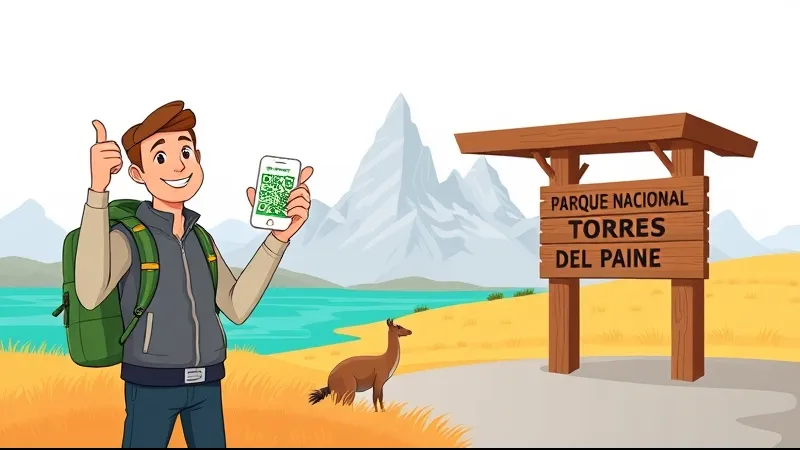
How do you buy a Torres del Paine entrance ticket on Pases de Parques?
CONAF's notice of 28 April 2026 confirms a continuous pass for two or more days, up to ten days, under the system effective from 1 May 2026. This does not by itself confirm repeated exits and re-entries. Before comparing ticket costs for separate day trips, ask PasesParques support through its Help page, giving your dates and planned entrances/exits. CONAF · PasesParques
The Torres del Paine entrance ticket is bought online, in advance, on Pases de Parques, the official ticketing platform of CONAF, the public body that administers Chile's national parks. The procedure is the same for everyone: open the platform, select Torres del Paine National Park, choose the date of the visit, choose the ticket category (non-resident or Chilean resident, adult or reduced), choose the duration option — a single day, or the "2 or more days" pass valid for up to 10 consecutive days — enter the full name and document number of every person in the group, pay with an international credit or debit card, and wait for the confirmation email.
What arrives by email is a nominal QR ticket. It is issued against the passport or identity document number typed at checkout, one QR per visitor, and it is not transferable. At the control post a ranger scans the QR and registers the visitor; the document used to book must match the one carried on the day. CONAF publishes the fee in Chilean pesos and requires the purchase to be completed at least 24 hours before the visit. Under the tariff in force since 1 May 2026, a foreign adult aged 18-59 pays CLP 32.400 for the day pass and CLP 48.500 for the multi-day pass. Always confirm the current table on pasesparques.cl before paying.
What is Pases de Parques and who operates it?
Pases de Parques is CONAF's own ticketing system, not a travel agency and not an intermediary. CONAF — Corporación Nacional Forestal — administers the Sistema Nacional de Áreas Silvestres Protegidas del Estado (SNASPE), the network of national parks, reserves and natural monuments that includes Torres del Paine, and it centralises entrance sales for those units on a single platform.
The practical consequence matters more than the institutional detail: pasesparques.cl is the only official channel for the entrance fee itself. Sites that offer to "secure" a park ticket for a service charge are not CONAF-authorised, and a ticket bought outside the official platform cannot be assumed to scan at the gate. Tour companies may include the entrance in a package, in which case they process it through the same official system — but the fee always originates there.
CONAF also publishes the park's operating information on parquetorresdelpaine.cl, which is the reference point for opening hours, seasonal restrictions and closures.
What information do you need before you start the booking?
Have everything ready before you open the form, because sessions time out and payment gateways are unforgiving. The checkout asks for:
- Full name exactly as printed in the passport, including both surnames where the document shows them
- Passport or identity document number — Chilean residents enter their RUT instead
- Nationality
- Email address where the QR ticket will be delivered
- Date of visit
- Ticket category: resident or non-resident, adult or reduced
- An international credit or debit card
The ticket is nominal and it is checked at the entrance, so names and document numbers must match the travel document character for character. A transposed digit is the kind of error that turns a two-minute gate check into a long conversation with a ranger. If you enter the data for every member of the group in a single transaction, the platform issues one QR per visitor — which is what you want, because each person is registered individually at the control post.
How much does the Torres del Paine entrance fee cost?
CONAF publishes a tariff table in Chilean pesos that distinguishes four things at once: non-residents from Chilean residents, adults from reduced categories, season, and single-entry from consecutive multi-day entry. The published figures currently in force, applied since 1 May 2026, are:
- Foreign adult, 18-59: CLP 32.400 for the day pass, CLP 48.500 for the "2 or more days" pass valid up to 10 consecutive days
- Foreign teenagers, 13-17: CLP 16.600 for the day pass
- Children aged 0–12: free
Chilean residents and senior categories pay different rates on the same table. Because tariffs are revised by administrative decision, treat any figure — including these — as something to verify on pasesparques.cl or parquetorresdelpaine.cl at the moment of purchase, and check the official site before budgeting.
Torres del Paine is among the most visited units of the Chilean protected-area system and one of its largest revenue generators, and entrance income is applied to park management: trail maintenance, ranger stations, signage and control. The fee is not a formality; it funds the infrastructure that makes independent trekking in the park possible.
Which ticket option suits your itinerary?
Choose by counting the days you will physically be inside the park boundary, not by counting the hikes you plan to do. That is the rule the pass has to satisfy.
- A day trip from Puerto Natales — a single-day pass is enough. You enter and leave the same day, and the QR is scanned once at the control post your route uses.
- A W trek — CONAF describes the W as a route of "3 a 5 días", so the multi-day option is the one that fits. It is valid for up to 10 consecutive days, which covers a W itinerary comfortably, including the buffer day that Patagonian weather so often demands.
- The O circuit — CONAF describes the Circuito Macizo Paine as "8 a 10 días", with a one-way restriction on the Serón→Paso section. The multi-day pass covers a standard O itinerary, but any trekker planning a stay that runs beyond the maximum consecutive-day pass needs to check CONAF's current provisions for extended stays before travelling rather than improvising at the gate.
Checked 13 September 2026: the current park notice requires an accredited specialist guide on Base Torres and the W from 27 April to 15 September 2026, or while the winter conditions persist. The June 2026 regulation limits W/Base Torres groups to four visitors per guide; an assistant does not count as a guide. Winter equipment is mandatory and the Base Torres entry cutoff is 09:00. Check current notices before travelling; a date alone does not guarantee access. Pases Parques · CONAF, 2026.
If you are still deciding between the two big routes, our comparison of the W Trek and the O Circuit sets out how the two differ in logistics, bookings and commitment.
Which park entrances accept the Pases de Parques QR ticket?
All of the official control posts do. The QR is scanned at whichever post your route uses: Laguna Amarga, Sarmiento, Laguna Azul or Río Serrano (Administración). At each one the visitor is registered by name, and at some posts a safety briefing is given before you are allowed to continue; CONAF's visitor regulations, published on parquetorresdelpaine.cl, make registration at every guardería mandatory, not optional.
Torres del Paine sits in the Región de Magallanes y de la Antártica Chilena and is designated a UNESCO Biosphere Reserve under the Man and the Biosphere Programme; Cerro Paine Grande is its highest summit, and the Base Torres viewpoint is the single most visited objective in the park. None of that changes the gate procedure, but it explains why the registration system is as formal as it is: this is a protected area with a legal framework, not an open trailhead.
Park opening hours follow the season — 07:00 to 21:00 from October to April, 08:00 to 18:30 from May to September — and rangers enforce entry cut-off times independently of your ticket. A valid QR does not override a closed gate.
Can you buy the ticket at the park entrance instead of online?
No. CONAF has moved Torres del Paine to advance online sale, with purchase required at least 24 hours before the visit, and arriving at a control post without a ticket already bought is the single most common problem reported by visitors.
A second practical issue makes it worse: mobile coverage at the control posts is unreliable, so "we'll buy it in the queue" is not a plan. Complete the purchase and download the QR before leaving Puerto Natales or Punta Arenas, while you still have a stable connection. Save the PDF offline on your phone and carry a printed copy as backup — paper does not run out of battery in a wind-blown queue, and a ranger can scan a print as easily as a screen.
The same applies if you are travelling in by bus. The 07:00 departure from the Rodoviario in Puerto Natales reaches Laguna Amarga at around 09:00; there is no useful window to fix a ticketing problem between the two. Our getting there guide covers the bus and transfer options in detail.
How do you complete the form if you do not read Spanish?
The platform's labels are in Spanish, and the fields are straightforward once you know what they mean. A short glossary of the terms that appear at checkout:
- nombre — first name (FR: prénom; DE: Vorname)
- apellido — surname (FR: nom; DE: Nachname)
- número de documento — document number (FR: numéro de document; DE: Ausweisnummer)
- extranjero — non-resident / foreign visitor (FR: étranger; DE: Ausländer)
- residente — Chilean resident (FR: résident; DE: Ansässiger)
- fecha de visita — date of visit (FR: date de visite; DE: Besuchsdatum)
- adulto — adult (FR: adulte; DE: Erwachsener)
- niño — child (FR: enfant; DE: Kind)
- temporada alta — high season (FR: haute saison; DE: Hochsaison)
Browser translation works as a fallback, but use it with care. Machine-translated pages regularly mislabel the residente / extranjero selector, and that single field determines which fee tier you are charged and which category the ranger sees when the QR is scanned. Check that selector against the Spanish original before you pay.
What can you do if the payment is declined or the ticket does not arrive?
Two failure modes recur, and both have a straightforward sequence.
The card is declined. Chilean payment gateways, WebPay among them, reject a fair number of foreign-issued cards on fraud rules. Try a different card, and call or message your issuer to authorise a transaction in Chile before retrying. Do not re-purchase until you have confirmed that the first charge actually failed — duplicate charges are far more tedious to unwind than a delayed booking.
The confirmation email does not arrive. Check the spam and promotions folders first; automated ticketing mail is filtered routinely, and delivery is sometimes simply slow. Keep the transaction reference from the payment screen — screenshot it — because it is the first thing any support channel will ask for. If nothing arrives, contact CONAF through the official channels published on conaf.cl rather than through third-party sites.
Can the ticket be refunded, rescheduled or transferred to another person?
The ticket is nominal and tied to a specific document number, so it cannot be transferred to another person. A friend cannot use your QR, and a name on the booking that does not match the passport at the gate is treated as an invalid ticket.
Date changes and refunds are governed by the terms published on Pases de Parques at the time of purchase. Read those terms on the platform itself before paying rather than relying on any summary, including this one — they are the operative text, and they are revised. It is also worth understanding the division of responsibility: when Patagonian weather forces a sector to close, that is an operational decision taken by CONAF and communicated through the park, not a cancellation processed by the ticketing platform. Build flexibility into the itinerary rather than expecting the ticket to absorb it.
What else must be booked besides the entrance ticket?
The entrance ticket does not authorise an overnight stay. This is the point that catches out most first-time visitors, and rangers verify it at registration.
Anyone sleeping inside the park must hold confirmed reservations for every night, at the campsites and refugios run by the park's concessionaires:
- West side — Vértice Patagonia: Paine Grande, Grey, Dickson
- East side — Las Torres Patagonia: Central, Chileno, Cuernos, Francés, Serón (the company formerly named Fantástico Sur — same firm, new name)
Wild and free camping is strictly forbidden under CONAF's park regulations. The CONAF map lists Italiano and Paso as ranger posts, not campsites, and treating them as places to sleep is not an option. Beds and platforms sell out months ahead in high season, so the realistic sequence is: secure accommodation first, then buy the entrance ticket for the dates the beds dictate.
Cancellation terms belong to the operators, not to CONAF. Las Torres Patagonia applies a published scale to individual trek bookings: no penalty 90 or more days out, 20% at 89-70 days, 50% at 69-45 days, and 100% at 44-0 days. Nightly rates are on the operators' own booking sites; check them there. For lodging outside the park boundary, our hotels section covers the bases in Puerto Natales and around the park.
Which park rules do you accept when you buy the ticket?
Buying the ticket means accepting CONAF's visitor regulations, which rangers enforce. The core obligations:
- Registration at every ranger station is mandatory under CONAF's visitor regulations
- Stay on marked trails — off-trail walking is not permitted under CONAF's visitor regulations
- No open flame of any kind. Any open flame is banned under Ley 20.653, with fines of up to CLP 2.000.000 and up to 3 years in prison; camp stoves may be used only in designated areas
- Pack out all waste, as CONAF's visitor regulations require
- No recreational drones under CONAF's visitor regulations — offenders are expelled from the park and reported to the DGAC
- Entry cut-off times on trekking routes, published by CONAF and applied by rangers regardless of your ticket
The fire rules are the strictest in the rulebook for a reason. The December 2011 fire started near Lago Grey on 27 December 2011 and burned more than 17.600 hectares; the scars are still visible from the trail. If you meet a puma, CONAF's official protocol is to stay calm, never run, never approach, and back away slowly while facing the animal.
How should you prepare the day you enter the park?
A short checklist, valid in any month:
- QR saved offline and printed. Coverage at the control posts is unreliable
- Passport in hand, matching the name and number on the booking
- Resident / non-resident category double-checked against the ticket before you travel
- Cash in Chilean pesos for shuttles and concessions — the Pudeto-Paine Grande catamaran operated by Hielos Patagónicos charges CLP 28.000 per person per leg, with children aged 10 and under free when accompanied by a paying adult; check catamaranpehoe.com for the current timetable, because sailings are weather-dependent and cancellations happen
- Layered clothing for rain, wind and cold. The park's own notice is explicit that the weather changes fast and that layers for rain, wind and/or snow are needed in any month.
Keep the ticket accessible without unpacking: it is checked before boarding some in-park shuttle services, not only at the gate.
If you would rather have the entrance, transport and guiding handled as a single booking, our comparison of guided W Trek tours sets out honestly what each format includes and where the trade-offs sit.
Frequently asked questions about the Torres del Paine entrance ticket
Is Pases de Parques the only official site to buy the entrance ticket?
Yes. Pases de Parques (pasesparques.cl) is CONAF's own platform and the only official channel for the entrance fee itself. Third-party resellers charging a fee to "secure" a park ticket are not CONAF-authorised; a tour company may include the entrance in a package, but it processes it through the same official system.
Can I buy the ticket on the day of my visit?
No. CONAF requires the purchase to be completed at least 24 hours before the visit, and tickets are not sold at the control posts. Buy and download the QR while you still have a reliable connection, before leaving Puerto Natales or Punta Arenas.
Do children pay the entrance fee?
Children aged 0–12 enter free, and foreign teenagers aged 13-17 pay a reduced day-pass rate of CLP 16.600 under the tariff in force since 1 May 2026. Free entry still requires the child to be registered in the booking, so include every member of the group in the transaction. Confirm the current categories on pasesparques.cl before paying.
Can someone else buy the ticket for me?
Yes — one person can pay for the whole group — but the ticket must be issued in the traveller's own name and document number, because it is nominal and one QR is generated per visitor. What cannot happen is using a ticket issued to somebody else: it is not transferable, and the ranger checks the document against the booking.
What happens if I enter through a different control post than the one I planned?
The QR is valid at the official control posts, so entering at Laguna Amarga instead of Sarmiento, Laguna Azul or Río Serrano is not in itself a problem. The ticket is scanned and you are registered at whichever post your route actually uses. What does matter is that the date, the category and the duration option on the ticket match the visit you are making.
Sources
- CONAF — Corporación Nacional Forestal — institutional information on SNASPE, protected-area administration and official contact channels. Consulted August 2026.
- Pases de Parques — CONAF's official ticketing platform — booking procedure, ticket categories, advance-purchase requirement and purchase terms. Consulted August 2026.
- Parque Nacional Torres del Paine — official park site — entrance tariffs in force since 1 May 2026, opening hours, control posts, visitor regulations, route descriptions for the W and the Circuito Macizo Paine, and 2026 seasonal closures. Consulted August 2026.
- Vértice Patagonia — official concessionaire, west-side refugios and campsites (Paine Grande, Grey, Dickson); availability and booking conditions. Consulted August 2026.
- Las Torres Patagonia — official concessionaire, east-side refugios and campsites (Central, Chileno, Cuernos, Francés, Serón) and published cancellation scale for individual trek bookings. Consulted August 2026.
- Catamarán Pudeto-Paine Grande, Hielos Patagónicos — fares, timetables and cancellation terms for the Lago Pehoé crossing. Consulted August 2026.
- UNESCO Man and the Biosphere Programme — directory entry for the Torres del Paine Biosphere Reserve. Consulted August 2026.
- Dirección Meteorológica de Chile, Puerto Natales station — monthly temperature means and prevailing wind data. Consulted August 2026.
- Ministerio del Medio Ambiente de Chile — national protected-areas information. Consulted August 2026.
- SERNATUR / Chile Travel, the national tourism board (chile.travel) — registration of tourism guides and regional visitor information. Consulted August 2026.
- Instituto Geográfico Militar de Chile (IGM) — cartographic and elevation reference for the Cordillera del Paine. Consulted August 2026.