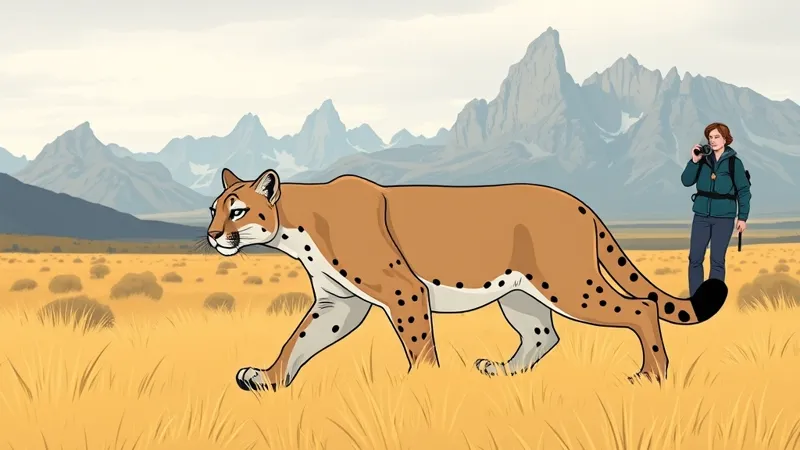
Why is Torres del Paine considered a leading place to see wild pumas?
Torres del Paine’s reputation rests on open landscapes, prey populations and established specialist wildlife tourism. These can make searching more practical, but wild pumas remain unpredictable: no sighting is guaranteed, even on a dedicated trip.
“Best place on Earth” is a reputation to examine, not a proven global ranking. The useful questions are whether terrain improves visibility, how prey influences puma movements, and how specialist observation helps visitors find animals without disturbing them. Those questions require ecological evidence, not promotional success rates.
Open ground can make an animal easier to detect than dense vegetation, but visible terrain is not necessarily occupied terrain. Panthera provides species and conservation context; local research is needed to explain this particular landscape.
What does scientific research explain about local pumas?
Puma ecology helps explain where searching may be worthwhile, but it cannot predict an individual encounter. Guanacos are an important prey species in this landscape; their distribution matters alongside cover, resting places and opportunities to move undisturbed.
Diet, habitat use and home range answer different questions. Prey remains reveal feeding patterns, while movement studies describe how monitored animals use space. Neither automatically measures how often tourists will see a puma.
The University of Chile repository is a research resource for locally relevant work. Population or home-range figures should only be interpreted with their study area, sampling method and study period—not converted into visitor sighting odds.
Tolerance is not domestication. A puma that does not immediately retreat from people remains a wild predator. Apparent calm is not permission to approach or interfere.
Where do puma-watching trips take place?
Trips may use the national park, surrounding private land or a combination; these are different access arrangements. A location name does not establish public access or permission to follow an animal.
Use CONAF for official park information and Chile Travel for broader destination context. An orientation map should distinguish Puerto Natales, the park boundary, public routes and private land—not mark recent sightings, dens or tracking coordinates.
Before booking, ask which land permissions the itinerary includes and what happens if a puma moves beyond an authorized observation area. Permission to enter land is not permission to pursue wildlife without limits.
When should visitors plan a puma-watching trip?
Choose a season for its travel conditions and available daylight, not a promised best month for pumas. Longer summer days offer more daylight for observation, but do not guarantee animal activity or visibility.
Winter brings shorter daylight and potentially more restrictive travel conditions. Shoulder-season departures also need weather-dependent flexibility. No season removes the possibility of seeing nothing.
Climate averages are not forecasts. The Chilean meteorological authority is the appropriate source for station-based climate information; conditions at Puerto Natales should not be treated as a forecast for every park location.
A longer stay creates additional viewing opportunities and room for disruption. It does not purchase certainty.
Why can nobody guarantee a puma sighting?
Animals move independently of itineraries, and encounters depend on visibility, weather, lawful access and observation effort. A puma may be concealed, outside the permitted area or simply somewhere the group never searches.
When evaluating an advertised success rate, ask:
- What reporting period does it cover?
- How large was the sample of outings?
- Does “sighting” include a distant glimpse seen only by the guide?
- Were cancelled or shortened outings counted?
- Does it describe this itinerary and season?
A refund or repeat-outing policy is a commercial condition, not a biological guarantee. Read its exclusions separately from any wildlife claim.
How can visitors compare responsible puma-watching tours?
Compare access, observation practices and practical requirements before comparing marketing promises. Torres del Paine Guide is an independent editorial and affiliate comparison site, not an operator, and runs no tours.
Comparison checklist: request these details for each product.
- Guide qualifications: wildlife experience, relevant credentials and safety procedures.
- Group size: maximum participants and how observation space is managed.
- Observation practices: no baiting, pursuit, crowding or pressure to obtain photographs.
- Permissions: national-park access versus authorized private-land access.
- Walking: terrain, expected walking and options for participants unable to continue.
- Vehicle use: travel arrangements and how much observation involves leaving the vehicle.
- Language: the language actually provided on the selected departure.
- Inclusions: transport, entry charges, meals and observation equipment.
- Cancellation terms: weather disruption, customer cancellation and outings without sightings.
Start with the puma-tracking tour page or private puma-watching option, then confirm the selected provider’s written terms. The current starting price is on the tour page; live prices and ratings belong in its GetYourGuide widget, not a fixed article quotation.
What logistics should visitors confirm before booking?
Confirm the entire door-to-door itinerary, not just the wildlife activity. “From Puerto Natales” does not necessarily mean every accommodation lies within the pickup zone.
Ask for written confirmation of:
- Departure point, pickup zone and return arrangements.
- Whether park entry and private-land fees are included or separate.
- Accommodation arrangements if the itinerary requires an overnight stay.
- Meals, drinking water and toilet access.
- Expected driving route and weather-dependent travel time.
- Walking distance, terrain and elevation gain, where applicable.
- Alternatives if roads, access permissions or weather disrupt the plan.
Do not substitute a regular park-bus schedule for a specialist outing’s transport plan. A late return, booked-out accommodation or a missed connection can affect the following day; none should be assumed away.
How should visitors behave around pumas?
Keep wildlife undisturbed and follow official instructions rather than treating a close photograph as the objective. CONAF is the authority for park rules and encounter guidance.
Its puma encounter protocol is to stay calm, never run, never approach, and back away slowly facing the animal. A guide does not remove all risk.
Responsible observation also means avoiding baiting, pursuit, crowding and interference with feeding or movement. These ethical expectations should be explicit in the provider’s practices; private-land permission does not make disturbance acceptable.
Prepare with windproof and waterproof layers, insulation and suitable footwear. Binoculars help with distant observation; camera equipment should never become a reason to move closer. Ask the operator what equipment it supplies and what clothing it recommends.
Can puma watching fit around the W Trek or a day tour?
Yes, but treat it as a separate activity with separate priorities and logistics. Wildlife watching involves searching and waiting; a sightseeing trip prioritizes viewpoints, while a trek follows an accommodation-linked route.
An incidental encounter on either is possible, but is not a substitute for a planned wildlife outing. For scheduling context, compare guided W Trek options and park day tours.
Confirm entry conditions, pickup compatibility, accommodation and physical requirements independently. Avoid assuming a same-day connection works without explicit confirmation from the providers involved.
What do visitors ask about seeing pumas?
Expect uncertainty, and distinguish recommendations from legal requirements.
Can I see a puma on a normal day tour?
It is possible, but a general sightseeing itinerary does not prioritize searching or prolonged observation. An incidental sighting is a bonus, never an inclusion.
Is a specialist guide required?
A specialist guide is recommended for interpreting wildlife and managing observation responsibly. Legal requirements depend on the route, season and land permissions; consult CONAF and the selected provider rather than assuming a universal rule.
Can a trip end without a sighting, and how long should I allow?
Yes. Additional outings provide more opportunities, not certainty. Choose a trip length that remains worthwhile even if no puma appears.
Can children join?
Eligibility depends on the operator’s current policy and the itinerary’s walking, waiting and safety requirements. Confirm suitability before booking rather than relying on a general age assumption.
Is a long camera lens necessary?
Not to enjoy observing wildlife. Binoculars can be useful, while distant photography may benefit from a longer lens. Confirm equipment arrangements with the provider and never approach to compensate for limited reach.
Sources
Official authorities support park and destination planning; research resources provide ecological context, not sighting guarantees.
- CONAF: park management, regulations and wildlife safety guidance.
- Panthera: puma conservation and species context.
- University of Chile repository: locally relevant research resources.
- Chilean meteorological authority: climate records and weather information.
- Chile Travel: official destination context.